
Reading Beyond Reviewing
Finding our reading 'true north', how to read closely, and writing about reading beyond book reviews

Foreword
My relationship with book reviews is the literal embodiment of “your biggest hater is someone you know” because I write book reviews and loathe them at the same time.
Don’t be fooled by this essay, this opinion totally comes from inadequacy. I still can’t figure out how to write a book review, try as I may!
Across my writing about how we enjoy books, I have discussed note-taking, written quotation studies and essays and also reviews. What encapsulates all of these modes of writing about reading is, in my opinion, reading closely. Close reading is a skill I explore in this newsletter: what does writing about books look like beyond a star rating?
This essay is for those that have an interest in book reviews, want to get into literary analysis and engage deeper with their reading.
Happy reading,
Jada
More writing about reading:


Previous newsletter:

On Book Reviews
For the longest time, book reviews have eluded me. I struggled to find worth in giving a book a rating within the parameters of five stars because it felt facile and constrictive; any less than five wasn’t quantifiable, but any more would spread my thoughts too thin. What constitutes a one star from a five star rating? What does the minuscule gap between four and four point five stars actually achieve? The current model and sheer simplicity of book reviews was unappealing to me as a reader because I was not the reviewer. Reading is a holistic experience that draws from multiple factors not shaped wholly by the words themselves, but by unique factors that form our own, personal literary landscapes; how books give shape to our future experiences; how they mingle with the past and our contexts; our personal paradigms for beauty1, enjoyment and value; the particular timing of when a book is read; our inclinations and idiosyncrasies.
My head begins to spin. The deceivingly simple framework of rating and reviewing books, of saying “this book is good,” or “this book is bad,” or “this book is not for me” becomes extrapolated, overwhelming, and dare I say meaningless.
I am relatively new to the review writing space, and so this confusion is born out of overthinking, but also from being a bystander, an outsider looking inwards. Since challenging myself to write reviews for every single book I read, I’ve reached a point where I have one foot in and one foot out.
In George Orwell’s 1946 narrative essay Confessions of a Book Reviewer, Orwell (who wrote upwards of 700 book reviews in his lifetime) states:
“[…] what meaning is there in the word ‘good’?
The best practice, it has always seemed to me, is […] to give long reviews– 1000 words at bare minimum.”2
The essay has a lot of humour and at times scathing opinions on the nature of book reviews in 1946. Eighty years later, I find myself with a similar discernment and chuckling in agreement with Orwell.
Every time I’ve sat down to write a review, an essay has come out instead. I have written short form reviews in my monthly reading lists, but it is the longer ones that capture my heart.
As an amateur reviewer, what I do know is this: a review that gives a star rating, a quip comment and a regurgitated summary of the book doesn’t achieve anything.
A Reading ‘True North’
Italian writer Italo Calvino’s reading taste, in translator Martin McLaughlin’s words, was “omnivorous”:
“What Calvino read was often metamorphosed creatively, intertextually, into what Calvino wrote.”
“These essays demonstrate how Calvino consistently appreciated the five literary qualities that he regarded as essential for the next millennium: lightness (Cyrano, Diderot, Borges), rapidity (Ovid, Voltaire), precision (Pliny, Ariosto, Galileo, Cardano, Ortes, Montale), visibility (Stendhal, Balzac, Flaubert), multiplicity or potential literature (Borges, Queneau). Perhaps, then, a further definition of what a classic is could be added to the fourteen definitions put forward in the elegant title essay Why Read The Classics?:
’A classic is a work which (like each of Calvino’s texts) retains a consciousness of its own modernity without ceasing to be aware of other classic works of the past.’– Translator’s Note by Martin McLaughlin, Why Read The Classics?
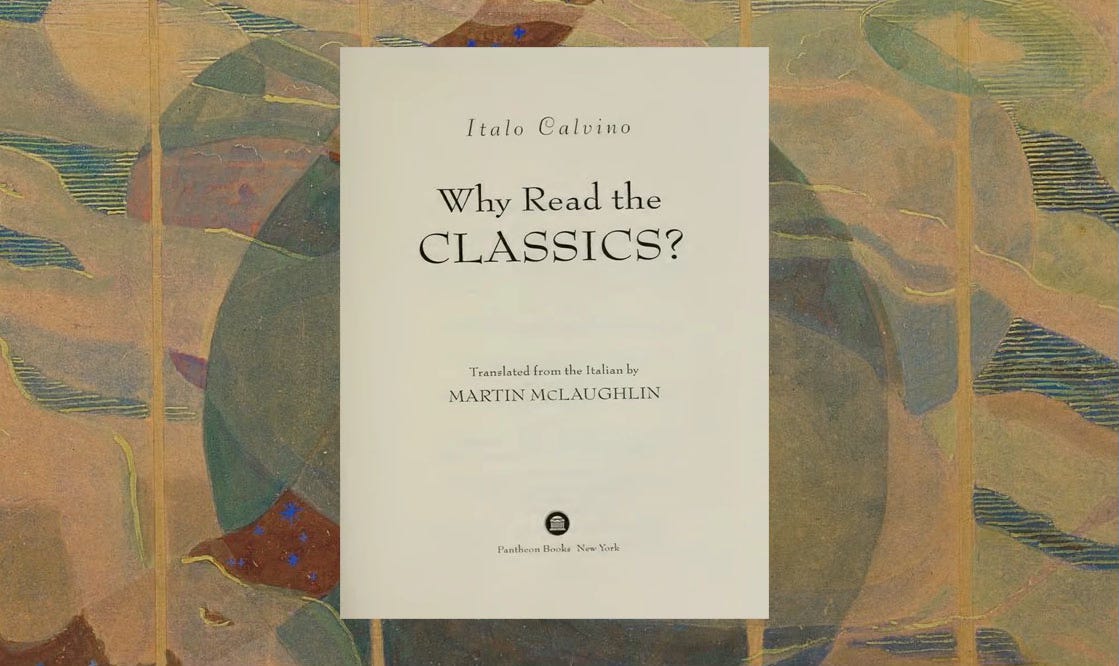
Why Read The Classics? is a 333 page, 14 clause list and 36 essay response to why it is important to read classics. Calvino provides acute literary criticism and personal analysis of some of the most fabled stories in human history with essay titles such as “The Odysseys Within The Odyssey,” a focus on “The Sky, Man, the Elephant” in regards to Pliny’s Natural History and Voltaire’s “Candide, or Concerning Narrative Rapidity” to name a select few. Alongside this literary criticism is an interrogation of what we read, but also how we read it and why we enjoy it.
McLaughlin’s anecdote about Calvino’s reading patterns show a penchant towards lightness, rapidity, precision, visibility and multiplicity. For Calvino, these make up his reading true north. To add to this, Calvino’s essays also show a wide variety of reading with seven on English texts, ten on Italian literature, nine to French works, four to classical authors, and two each from Russian and Hispanic writers. He “held a high aesthetic regard for brief texts (of no more than one hundred pages)” and in the collection’s introduction, writes:
“[Reading can be] literally formative in that it gives form or shape to our future experiences, providing them with models, ways of dealing with them, terms of comparison, schemes for categorising them, scales of value, paradigms of beauty: all things which [..] operate in us.”
In this quote, Calvino acknowledges how reading “operates in us” and creates a comprehensive profile of what being a reader is– our contexts; experiences; memories; comparisons; what we find beautiful; how we organise the world; what is important to us. And so, reading (and therefore writing about reading) becomes an amalgamation of the above, combined with our personal reading tastes and resonances.
That is a reading true north. The invisible current that we will always be drawn towards and what it reflects back at us.
My Reading ‘True North’
‘True North’ is an idiom and metaphor not about physical direction, but internal, moral compasses. It is our personal orienting point; our fixed point in a spinning globe. Despite being popular in the 1990s in business and leadership contexts, when we observe writing about reading like Calvino’s and interrogate the current model of book reviews, its ideas around calibration and alignment, of following what feels right to us, can also be applied to reading.
My personal profile as a reader, and therefore how my reviews and wider writings are structured, begin through noticing a combination of syntax and thematics. These are the two driving factors behind my annotations, my own reading north star.
I like books with shorter chapters; I like books that make me feel hopeful; I like books that read like poetry; I like books about books; I like books with quirky old women as the main character; I like books written by women; I like books that are translated; I like surrealism; I like magic; I like literary criticism; I like polysyndeton; I like writing that challenges language; I like mythology; I like epics; I like meditations; I like geese and swans; I like space and the great unknown; I like wonder and awe; I like iconography and symbolism.
Go down the rabbit hole, read books in thematic or energetic pairs, create mindmaps and research, open a concerning amount of tabs on your computer! Through curiosity and noticing what we are reading, how we are reading it, and why we are reading it, our own personal reading ‘true norths’ can grow akin to that of Calvino’s.
“Don’t be amazed if you see my eyes always wandering. In fact, this is my way of reading, and it is only in this way that reading proves fruitful to me. If a book truly interests me, I cannot follow it for more than a few lines before my mind, having seized on a thought that the text suggests to it, or a feeling, or a question, or an image, goes off on a tangent and springs from thought to thought, from image to image, in an itinerary of reasonings and fantasies that I feel the need to pursue to the end, moving away from the book until I have lost sight of it. The stimulus of reading is indispensable to me, and of meaty reading, even if, of every book, I manage to read no more than a few pages. But those few pages already enclose for me whole universes, which I can never exhaust.”
– Italo Calvino, If on a Winter’s Night a Traveler
Going Deeper: On Close Readings
So, where does all of the above leave us as a reader? We are positioned at a crossroads: to write the witty, no-substance review, or to look a little bit closer with our reading true north in our back pockets.
Literary criticism, analysis, and engaged reading are a funnel. Book reviews sit at the top, but delving even deeper into the question “how do we read?” allows us to process our feelings and perspectives. When we pair the how with the why, a transmutation takes place that elevates the reader, reviewer and writer to engage in conversation about books beyond reviewing.
To read beyond reviewing, we must first change how we read.
So how should we read? Closely.
A close reading changes the position of a reader from one of passivity (simply enjoying a book) to proactivity (engaging with a book). It is both a process whilst we are actively reading a book, and an act of transmutation afterwards. This method of reading, and writing about reading, shifts reading beyond comprehension and the box of star ratings into the realms of analysis and interpretation.
One book read closely has far more value than ten read normally, which is why taking the time to write about what we are reading afterwards is important.
This explains my toil with the current surge of book reviews on Goodreads, Fable and Storygraph, because they feel like mere observation. Close readings allow readers to witness the process of creativity and provide them with a framework to experience the world.
In order to read closely, we must observe:
Ideas and themes
Representations
Values
Interpretations
and their relationship with diction, syntax and/or literary devices. Character, dialogue, plot, setting, and rhetorical devices all become magnifiers for interpretation, enjoyment, and reading closely.
For example, in “The Odysseys within The Odyssey,” Calvino is drawn to the framework behind journeys and how Homer’s epic, through memory, homecoming and the risk of forgetting, creates a universal tale of loss, and ultimately, return. He writes about this central idea by examining Odysseus’ antagonists and their relationship with forgetfulness, and also how storytelling serves the role as a medium for survival. This is the lens from which Calvino reads, and how he interprets and ingests The Odyssey. Homer’s poem, in this way, is not ‘good’ or ‘bad’ (despite it being a difficult read at the best of times) but to Calvino, it is an exploration of nostos (homecoming) and about defining oneself against the dangers of oblivion:
“Perhaps The Odyssey is the myth of all voyages? […] He simply recounted the same experience now in the language of reality, now in the language of myth, just as for us even today each journey we undertake, big or small, is still an Odyssey.”
The closing paragraph, and in particular, sentence of this essay illustrates the point of close readings better than I could explain it. It is “the question of attention.”3
When we read, are we paying attention to things beyond good and bad? Beyond us?
But HOW?
I will acknowledge that I haven’t really provided a framework or structure on close reading. Two-thousand words in, and I haven’t taught you how to close read, but simply declared that book reviews suck and that you should. Close readings are not a framework to follow, but an encouragement to develop critical thinking and “appreciate the aesthetic use of language; evaluate perspectives and evidence; and challenge ideas and interpretations.”4
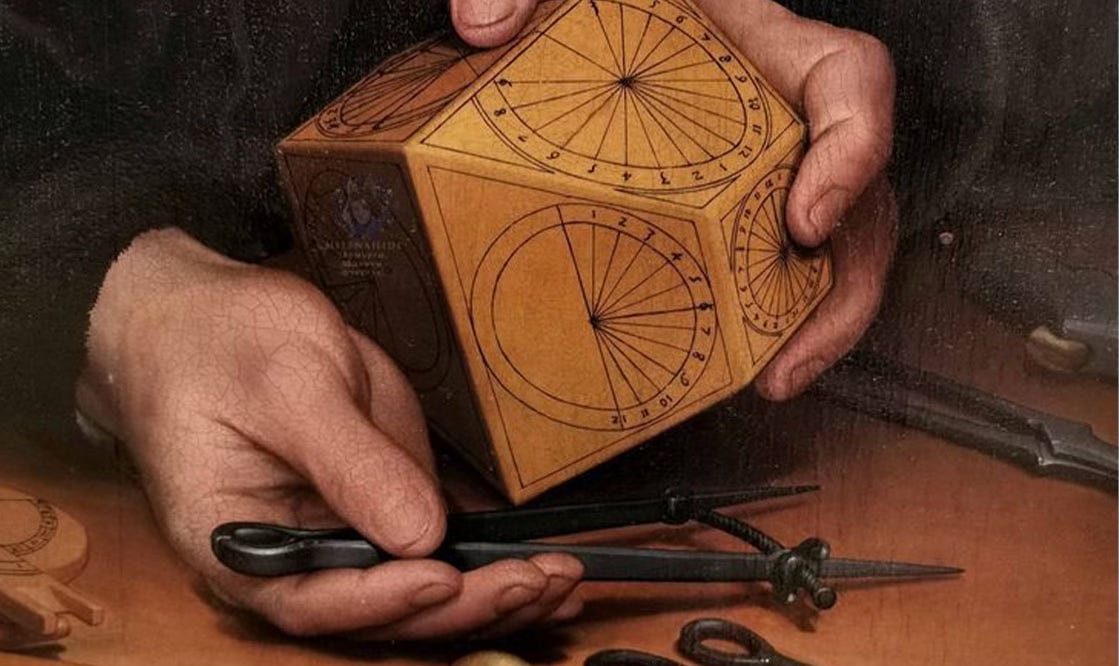
This can be achieved in multiple formats because close reading is a method, not an instruction manual.
Noticing our reading true north allows us to resonate with specific ideas and themes within a text. Why are we drawn to this? Or even the opposite: why are we not?
Consider analysis as a funnel:
The idea, theme, or understanding you would like to focus on
Noticing your annotations and underlined passages that relate to the idea (this is your starting point)
Do these annotations (or, evidence) belong to any literary devices?
How are the pieces of evidence, both individually and collectively, contributing to the idea?
What does the author achieve by using the above?
How do you feel about it?
Through the process of reading closely, writing about reading can then take on many other forms of discussion: quotation studies, critical analysis essays, comparisons, presentations and above all else conversations. That is what a review should be: dialogue between readers.
A strong book review utilises all these elements to create discourse and discussion about the books we are reading. It is through discussions like these that, like Calvino’s interpretation of odysseys, we begin to have more expansive contemplations.
I’m not going to tell you how to write a ‘good’ book review, because that is entirely not the point; writing about books, in any and all forms, is as natural as the cycle of life and death. Yin and yang. Sun and moon.
Why I Write About Reading
“While the hemlock was being prepared, Socrates was learning the flute. ‘What use will that be to you?” he was asked. ‘At least I will learn this melody before I die.’”5
When I write about reading, I want to suck the marrow out of life; out of the indescribable combination of literature and words and ideas and reading with curiosity and zeal; to analyse and share and discuss with the same vigor, so that ultimately, reading may be as infectious as laughter.
I want to be laughing until I’m weeping and weeping until I’m laughing. Is that not the ultimate melody, when we read, write, weep and laugh together? Now that is an odyssey.

Afterword
I haven’t been writing on schedule this month; Sunday rolls around and I turn whatever draft I have written upside down and inside out. What I have been doing is writing much longer essays that require more research and time.
Turns out my scathing opinions re: the model of book reviews goes beyond venting and actually has some sauce to it. I had another essay planned in reference to Italo Calvino and Why Read The Classics? but felt compelled at the last minute to include it here because of relevancy. I have written about Calvino before, and will most certainly continue because I have even more notes and thoughts about WRTC? aside from this article.
So expect more writing about reading and more writing about Calvino from me in the near future.
Above all else, when it comes to writing this newsletter, I’d rather do it imperfectly as opposed to not at all. Thank you for reading and sharing this space with me; during my last newsletter I was celebrating 1000 readers and now there are (currently as I write this) 1700 of you!
Thank you for sharing this space with me and see you next Sunday (if I can get my schedule organised and stop posting a day late),
Jada
✷
@fujijada
jadadeluca.com
deluca.jada(at)gmail(dot)com

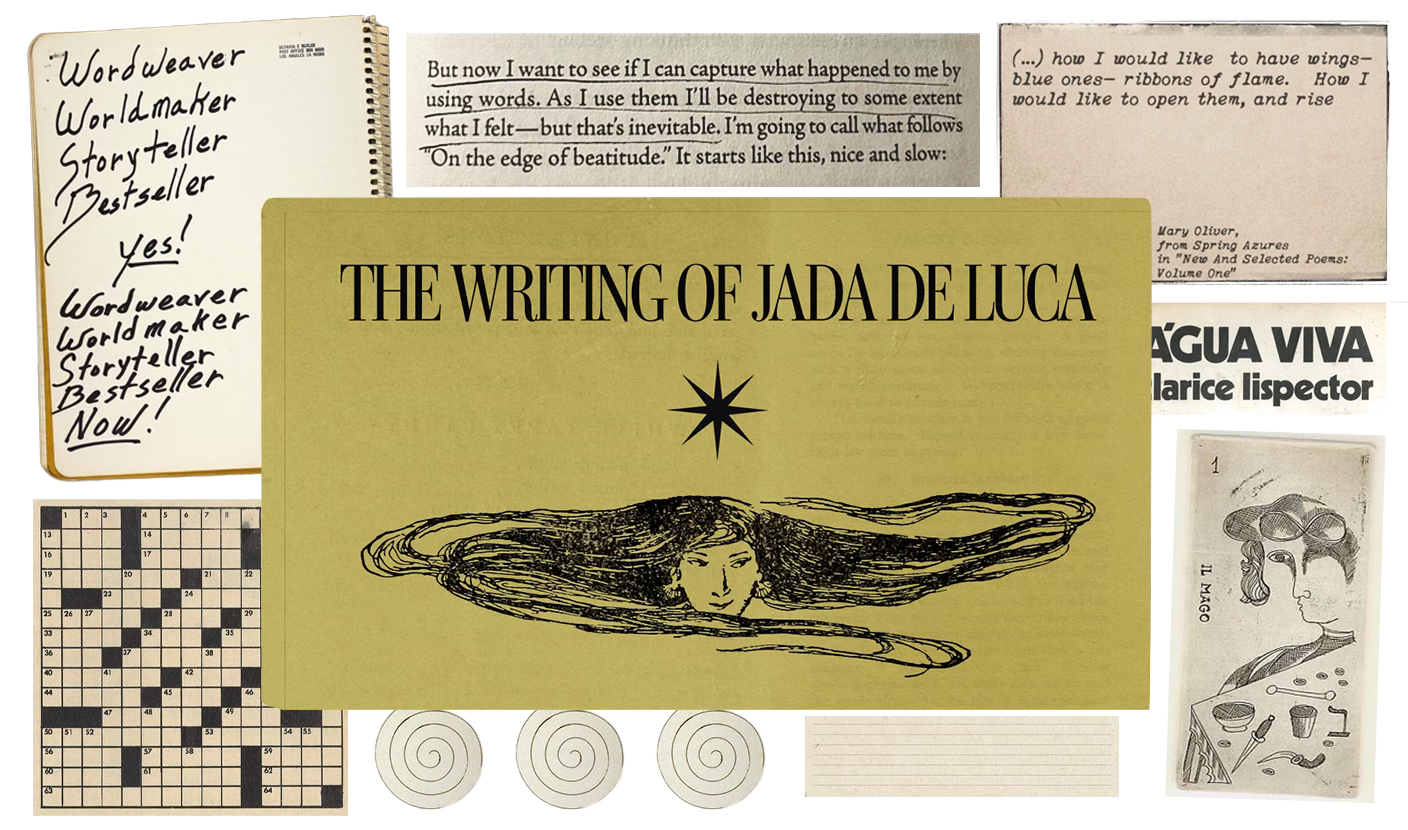
Italian-Samoan writer Jada De Luca is a visual narrator, storyteller and devout journaler. She writes about leading a reading and writing life, inspired by Mary Oliver’s poem Sometimes:
Instructions for living a life:
Pay attention.
Be astonished.
Tell about it.
Telling stories through both written and visual narration (she is also a collage artist) is her way of paying attention to the magical, surreal, and intensely personal landscapes that the arts offer. Her newsletter is a source of her entire writing career; her oeuvre; a commonplace journal of essays about literature, language, writing, travel and art.
Jada’s favourite novel is Água Viva by Clarice Lispector, her favourite tarot card is The Magician, and she likes her tea with an extra sugar.
Italo Calvino, “Why Read The Classics?” (1991)
George Orwell, “Books v Cigarettes” (1946)
John Guillory, “Close Reading” (2025)
Jennifer Shand, “The Close Reading: An Inquiry Approach” (2014)
Emil Cioran, “Drawn and Quartered” (1979)
i love this so much <3 this is part of why I think book clubs are so great. you can talk about all facets after a close read with others instead of boiling a book down to //5 stars.
we write about similar topics girl/would love to subscribe to read more of each others' works !!
Love this!!!! I also struggle with reviews because a “I gave this 5 stars because I was giggling and kicking my feet the entire time” and “I gave this 5 stars because this book rewrote my soul” are two VERY different vibes. I’ve been trying to do more close reading this year and it’s been fairly successful! I’ve also started writing reviews in a journal immediately after finishing the book, and getting my thoughts on literal paper has helped me organize them a lot and sort through what worked for me and what didn’t in the book.