
Femme-Surrealism & The Mystery of Creation
How Surrealist artists Remedios Varo and Leonora Carrington paint the origins of the universe through paradox and harmony

Foreword
One of my favourite books is Leonora Carrington’s The Hearing Trumpet. It is all things wacky and womanly; witchcraft-ian, speculative, apocalyptic, absurd, magical. I posted the cover (pictured above) on my Instagram story once with the caption:
“Now this… This will be my final form.”
My words are an aspiration I share with many women. Oh, the yearning to be looming, bird-like figures that stomp around barefoot in our pillowy dreamscapes!
International Women’s Day seems like a fitting occasion to start sharing my writings on two of favourite female surrealist artists: Leonora Carrington and Remedios Varo. This article is for people interested in Surrealism, art analysis, female artistry and how art answers our deepest questions.
Happy International Women’s Day and happy reading! This piece is dedicated to my mom, who taught me how to paint and write. <3
Love,
Jada
Previous newsletter:

Creation is our Great Mystery: where do we come from? How were we created? Why were we created? What came before us? What comes after us?
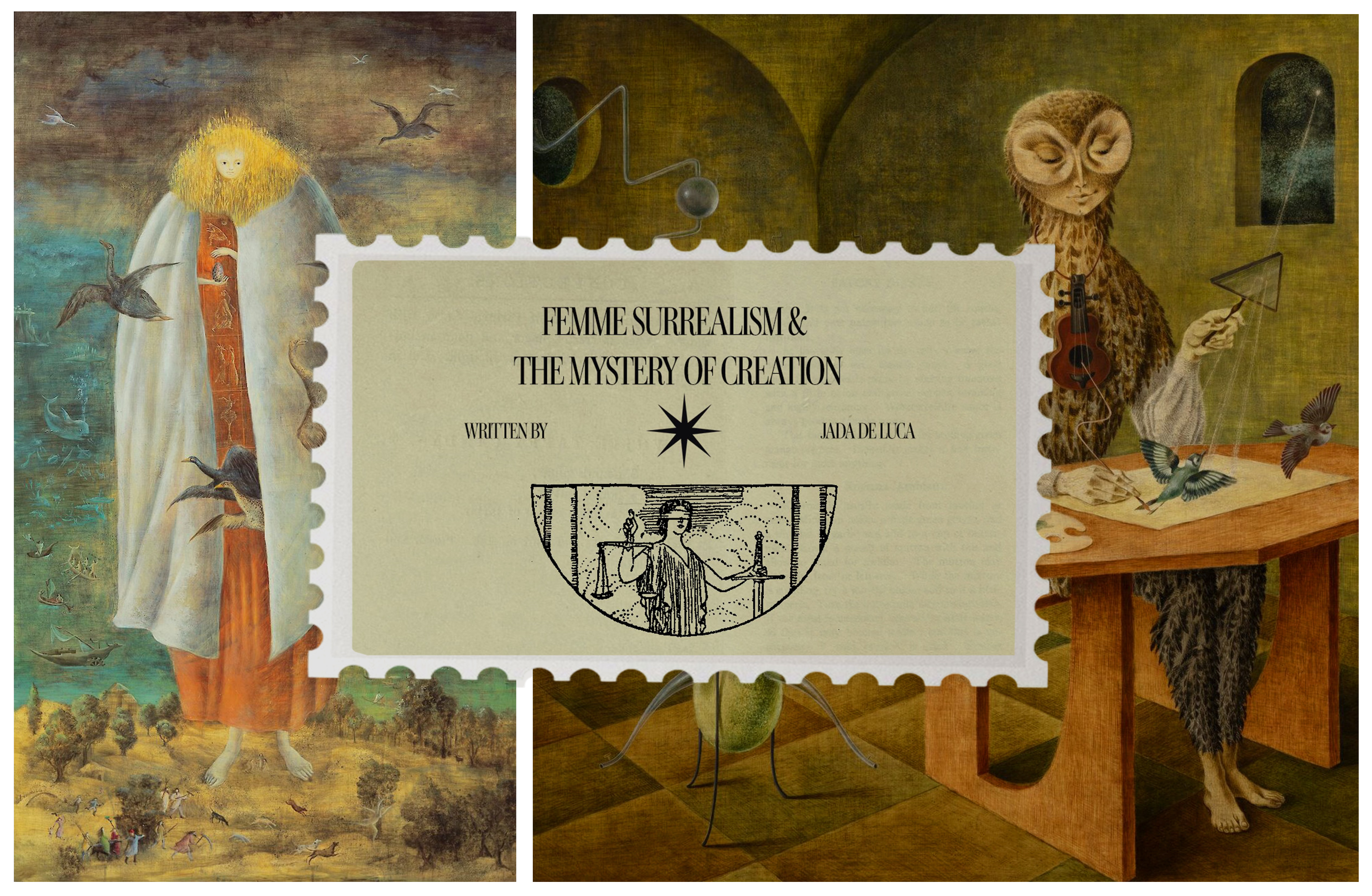
Creation of the Birds (1957) by Remedios Varo and The Giantess (1947) by Leonora Carrington are two femme-surrealist works that attempt at an answer, using alchemical elements, spiritual symbolism and a metaphysical exploration of creation to suggest that the artistic and philosophical pursuits of women are integral to the discussion surrounding the origins of the universe. In conjunction with the Great Mystery, these paintings represent the crucial role of Femme Surrealism in elevating women from the femme-enfant and transmuting their experiences and domestic lives, exploring themes such as identity, autonomy, motherhood, mental health and personal trauma. The result of this artistic shift was women being initiated as prolific meditators of the great mysteries we aim to answer through science, religion, philosophy and mathematics, and instead doing so through art.
Carrington and Varo achieve this synergy of internal experience and existential contemplation through transmutation. Both artists viewed creation as a process characterised as being both incomprehensible and unexplainable except through magical, prophetic and artistic means.
Carrington stated that she was “as mysterious to herself as [she] was to others” and that even if others didn’t believe in magic, “something strange is happening at [these] very moment[s].”
Where Carrington uses ‘strange’ to describe the indefinable, Varo expressed similar sentiments as ‘mystery’:
“I deliberately set out to make a mystical work... in the sense of revealing a mystery, or better, of expressing it through ways that do not always correspond to the logical order, but to an intuitive, divinatory and irrational order.”
Perhaps the answer to ‘revealing’ the Great Mystery lies in how these two artworks pursue harmony and contradiction; Varo deemed the yin and yang as “the most beautiful symbol of all” and even titled one of her works Useless Science or The Alchemist. Even the title of this work creates a paradox between two opposing forces, and makes us question: is the pursuit useless? What does contemplating our greatest mysteries achieve? How do we learn to live with the incongruity of not knowing?
For both artists, alchemy was an important philosophical and pseudoscientific method that inferred their work. Creation of the Birds and The Giantess are two paintings that are testimony to this, in the way that they bridge the gap between logical and illogical, rational and irrational, reality and fantasy– an alchemical process of a metaphysical nature.
“I am trying to find the invisible thread that unites all things.”
– Remedios Varo, 1956
In their most basic definitions, alchemy and transmutation reference transformation, the process of turning a base material such as lead into noble metals like gold. Alchemists sought answers to creation and existence through the combination of proto-science, philosophy and mysticism. Within the context of art, Surrealism, and these two artists, a sublime metaphorical alchemy takes place upon these paintings, rising above the desire for the Philosopher’s Stone or for gold, and instead, seeking answers to the questions we ask the sky.
On Creation of Birds by Remedios Varo
1 kilo of horseradish; 3 white hens; 1 head of garlic; 4 kilos of honey; 1 mirror; 2 calves’ livers; 1 brick; 2 clothespins; 1 whalebone corset; 2 false moustaches; hats to taste.
The above list is Remedios Varo’s recipe on How to Produce Erotic Dreams, not only demonstrating a penchant for humour, but also an attraction towards how synergy and conflict combine; a clashing of science and magic in the production of art. Like Leonora Carrington, Varo was also a writer, and this list has signifiers of her style whilst simultaneously signposting common themes she explored in her artwork, and how they were mixed, contrasted, complemented and therefore alchemised.
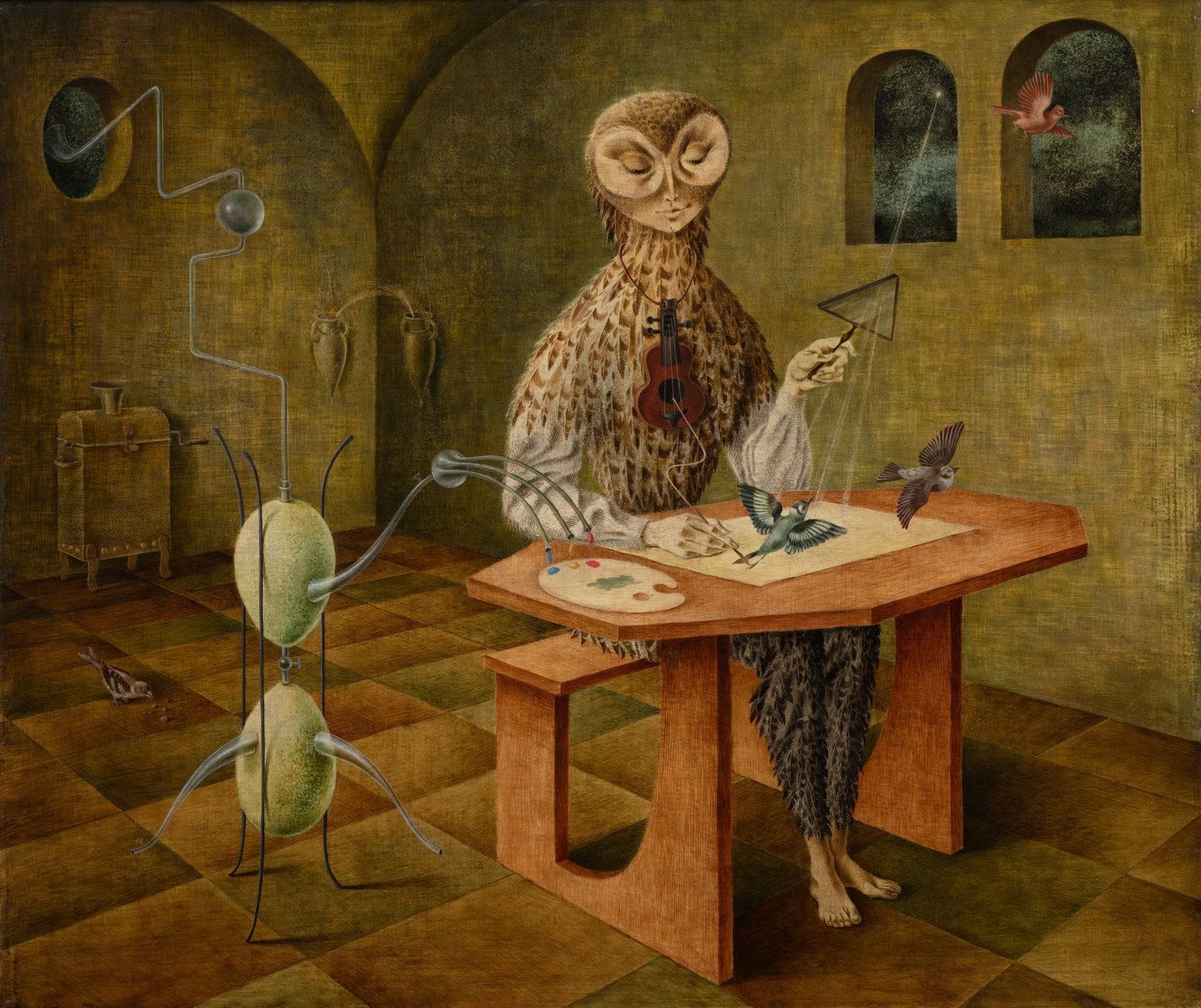
Creation of Birds is oil on masonite, painted by Varo in 1957. In it, Varo elevates the status of women through painting them as creatures engaged in an esoteric quest for knowledge, and also ponders on the nature of our existence.
Like the list, Varo uses the contrast of symbols to portray her opinions and desires as an artist. For Varo, the highest aspiration was achieved through a combination of colour, light, art, science and magic. There exists a harmony within these opposing forces; Varo does not simply compare and contrast, but Creation of Birds becomes a canvas for a profound elemental mixture wherein hard science is placed directly next to, and interplays with, esoteric mysticism.
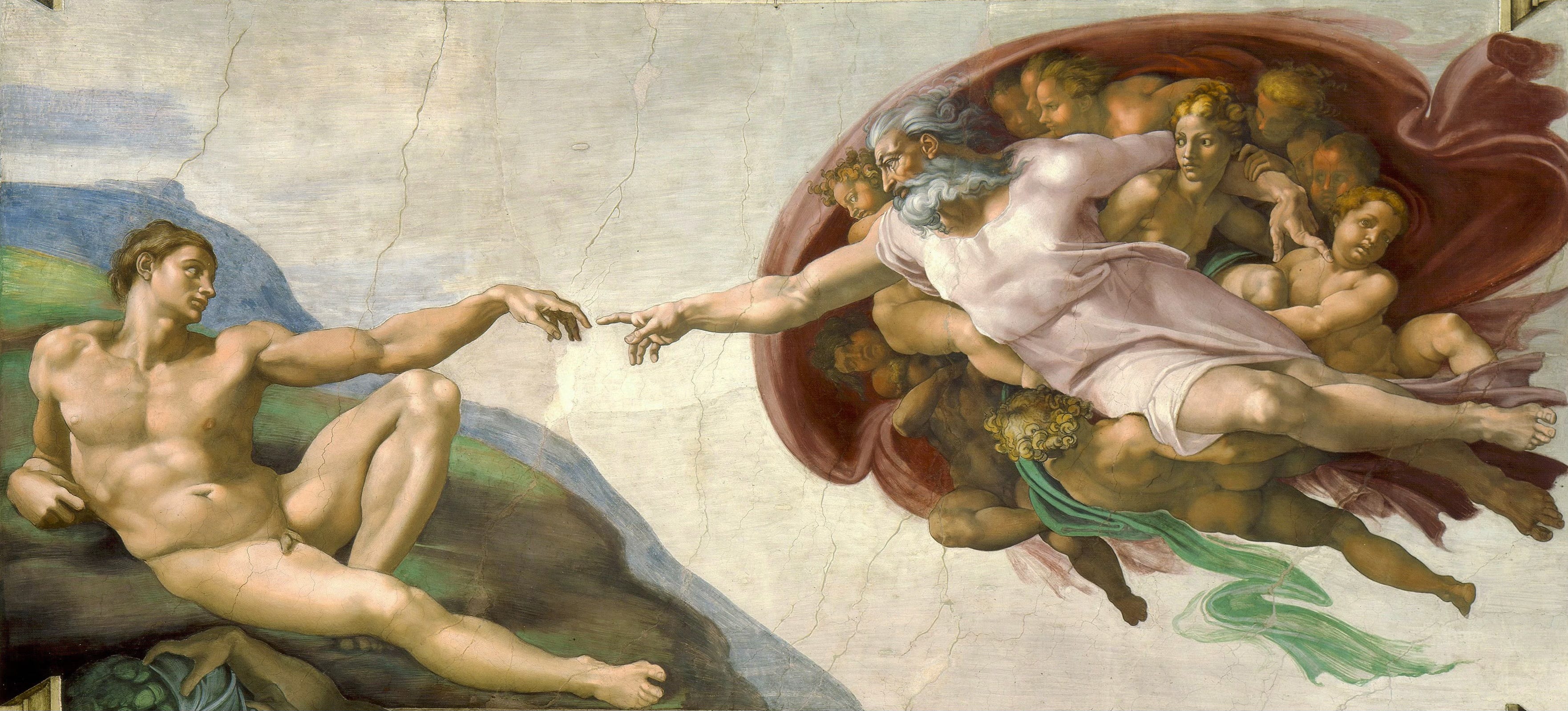
In Creation of Birds, Varo interrogates a common archetype for wisdom, the owl, and superimposes Woman as creator, with the painting depicting a hybrid owl-woman sitting at a desk, creating birds that are flying off into the night. There are multiple suggestions within this image: women as scientists, artists, alchemists. The painting has an almost biblical undertone, with the title reminiscent of The Creation of Adam/Creation of Man by Michelangelo. Perhaps Creation of Birds is Varo’s own take on Genesis:
So God created mankind in his own image, in the image of God he created them
– Genesis 1:27
Whilst Varo was not religious, her mother was a devout Catholic and she grew up in a strict household. She often used religious iconography in direct contrast against the scientific and spiritual symbols in her work.
Alternatively, Creation of Birds mimics the mythology of Daedalus, who not only designed and sculpted the labyrinth that would enclose the Minotaur, but also created wings for himself and his son, Icarus, with feathers, thread and beeswax. Pygmalion also comes to mind, who through prayer to the goddess Venus brought his sculpture to life. All of these readings infer creation of outstanding and fantastical means, whether through natural material, spoken word or godhood. Multiple mythologies and beliefs can be interpreted in Varo’s works because of her diverse symbolism, and when we consider this, Creation of Birds becomes her own personal rendition of the birth of the world.
The owl-woman (an archetype of wisdom) holds a magnifying glass in her left hand from which light from a distant star is refracted, bringing birds from their nest on paper to life as they take their first flight. Bird-woman and bird-creation suggest being made in the same image, deifying the figure in the painting. Varo was also interested in the work of astrophysicist Sir Fred Hoyle who wrote The Nature of the Universe (1950), which is about the creation of the sun being from stardust and gas; alchemy of a celestial degree. Varo channels this through the magnifying glass into a much smaller, but equally as important subject, the birds.
Birds are commonly associated with freedom, and the red bird in the upper right of the canvas flying into the night suggests the bravery of transcendence into the unknown, an undertaking that all life experiences. In the same way the devout would suggest that we have been created in the image of God and thrust upon an unyielding world, so too does this painting reveal a woman wielding the cosmos and having to release her creation into the night. Femme Surrealism was often motivated by the personal experiences and autonomy of women, and perhaps Varo creates an intricate allegory for birth in this painting, showing us a mystical portrayal of the alchemical womb.
The organic element of birth and the birds is contrasted by the process of refraction, where when light passes through a magnifying glass (from air to the density of glass), it slows down and changes directions. This process gains a resemblance to Newton’s Triangular Prism, suggesting that the powers of women are equally cosmic as they are mathematical. In Newton’s Prism experiment, he discovered that white light is not pure, but a mixture of colours. Yet another instance of transformation in this painting.
In her right hand, the owl-woman holds a paintbrush to paper, next to a paint palette that has red, yellow and blue. Varo introduces another triadic symbol alongside the magnifying glass. All colours can be made from primary colours, they are the foundation of all paintings, and therefore, the pursuit of creation is a scale that balances artistic and mathematical pursuits. Varo contemplates the origins of our universe in Creation of Birds and suggests that the presence of the artist is foundational to this idea; with the magnifying glass in one hand (science) and the paintbrush in the other (art), these dual forces combine to create the birds. The duality that Varo describes when she “expressing [mystery] through ways that do not always correspond to the logical order, but to an intuitive, divinatory and irrational order” is shown as the owl-woman uses both her left and right hand, corresponding with each side of the brain. The left side of the brain, responsible for logic, and the right side, responsible for creativity, conjoin quantitative and qualitative forces.
Varo then adds a third variable to create a triadic equation of creation with the placement of the violin on the owl-woman’s chest from which the brush is drawn from. Alongside science and creativity, creation also becomes a matter of the heart.
In her library, Varo kept a copy of The Alchemists: Founders of Modern Chemistry by F. Sherwood Taylor. Notably, next to the owl-woman’s desk is alchemical laboratory equipment. Paint is a form of chemistry that transforms into a painting, which serves as a visual representation of the transmutation of thought and idea. Like the central figure being a combination of animal and human, and the birds being created from glass and light, the chemistry equipment is also a unique combination: it is both mechanical, mimicking glass tubes and pipes, and organic, due to the egg-shaped containers that house the paint coming out of three glass ‘veins’. These opposing associations combined into the equipment create a unique synergy as Varo endeavours not to compare them, but merge them, further denoting the paradoxical nature of alchemy and creation. In using eggs (a symbol of fertility and birth) as alchemical equipment, Varo suggests that creation is a combination of even more opposing forces, showing the process of creation as it transitions from chemistry, to colour, and then ultimately to form.
Creation of Birds combines the organic, mechanical, intellectual and metaphysical to suggest the ultimate alchemy and explore all opposing energies of creation. The painting assumes the artist and woman into a mythopoeic role as maker of worlds. Whether this refers to fantasy or real worlds is up to debate, to which Varo refutes:
“The dream world and the real world are the same.”
In painting this dream world, Varo notes to the real world, and the Great Mystery of all worlds.
On The Giantess by Leonora Carrington
Whilst I finished writing about Varo with eggs, that will be our starting point with Leonora Carrington.
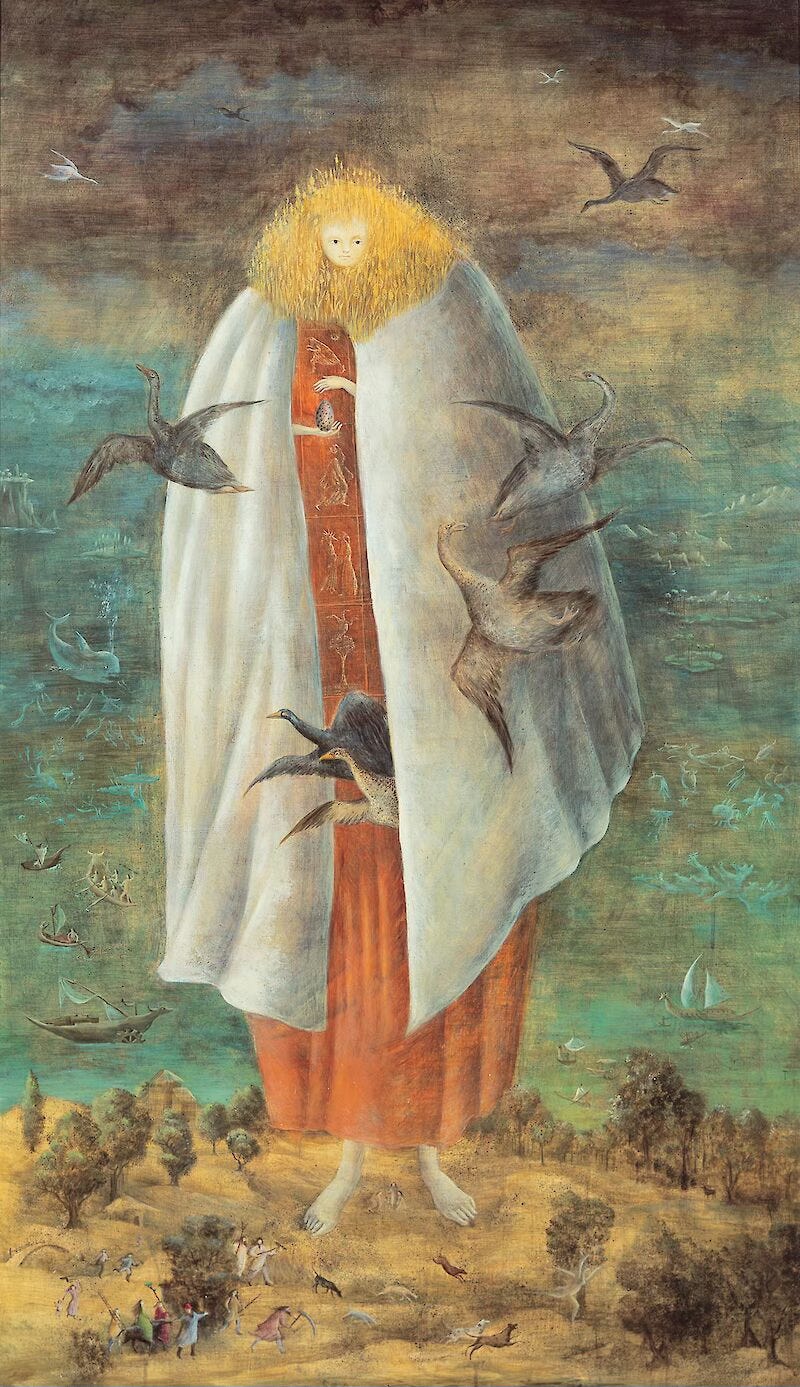
The Giantess, painted five years after becoming a resident of Mexico, also utilises the iconography of birds, eggs, and bird-women to a similar effect as Varo’s Creation of Birds, but expands upon the idea of alchemy and paradox through the visual composition and the materials used. Carrington used egg tempera, an emulsion of yolk, vinegar and raw pigment, which was popular before the rise of oil paint. The idea of chemistry and mixing by Varo in Creation of Birds is exemplified in The Giantess through medium. Egg tempera is a fast-drying medium that creates a matte finish. Due to its opaqueness, layering techniques are responsible for that luminous and ethereal look that Carrington’s Giantess has. When laid onto a wooden panel, tempera dries into a powdery surface that is “well suited for ineffable entities.” What adds to the luminosity is the halo effect around the head, due to the giant woman’s grain-like hair, which was often observed in Byzantine icons adorned with nimbuses, also deifying the central figure and elevating the representation of women.
In Carrington’s words in a letter to the collector Edward James, the painting is:
… a sort of giantess with a moonlike face in a field of wheat which is also golden hair. Her cape is white and she has a russet red dress with panels in which birdlike people are conversing. Out of the cape come wild geese which encircle her. She is standing against a sort of turquoise sea in which are small islands.
The alternative title for this painting is The Guardian of the Egg. Said egg is not only the titular but also the visual centerpiece of this painting, and despite being one of the smallest elements in the painting that is cradled in the Giantess’ hands, its message concerns contemplations of a grand scale:
“The egg is the macrocosm and the microcosm, the dividing line between the Big and the Small.”
In her 1943 memoir, Down Below, Carrington describes how both the Big and the Small are reflections of each other. This has been observed by many, for example in the way that the spiral of the Milky Way can also be found on the smallest of seashells. Carrington’s egg allows us to question creation and the universal symbol of life on such a small scale that it encompasses all things and becomes larger than itself, once again, showing the paradoxical nature of alchemy in relation to creation.
The alchemical egg (or cosmic egg, world egg, mundane egg) is a mythological motif and symbol of the round universe. It is the beholder of all potential: the cycle of creation and rebirth. When we pair alchemical synergy suggested by Varo with Carrington’s mythology of the egg, woman as creator becomes cosmic and all-encompassing. The composition of painting the egg in such a miniscule way that is beheld by a large, goddess-like woman, is Carrington’s way of expressing this; a symbol not only of fertility, but of the cosmos itself, the ‘unhatched’ potential of all life. It makes viewers think of both unity and incubation, and nature’s fantastical and unexplainable phenomenon of a chick hatching from seemingly innate matter.
Focusing on the alternative title, the word ‘guardian’ encourages a protective role for the Giantess. This is reflected twice in the painting (often missed and also painted very small) where between the Giantess’ feet stand three women. Other figures at the bottom of the painting are reminiscent of Paolo Ucello’s Hunt in the Forest (1470), suggesting that the women are being protected by the Giantess.
‘... the father was the planet Cosmos, represented by the planet Saturn: the son was the Sun and I the Moon, an essential element of the Trinity, with a microscopic knowledge of the earth’
Later, with full lucidity, I would go Down Below, as the third person of the Trinity. I felt that, through the agency of the Sun , I was an androgyne, the Moon, the Holy Ghost [...] Leonora Carrington, and a woman.
Akin to Varo, Carrington had an interest in triadic symbolism. The three women at the bottom of the painting can also be read in multiple contexts: the Three Fates/Moirai, (Clotho, Lachesis and Atropos) as personifications of destiny; the Triple Goddess (Maiden, Mother and Crone) which is an archetype for the distinct stages of life; the Three Witches in Macbeth that predict both his ascension to kinship and his downfall; the three women present at the crucifixion and resurrection of Jesus. Individually, all of these supersede the role of women as being femme-enfant. These contexts instead portray them as heralds for the cycle of life, of divinity, of resurrection. Perhaps the most similar instance of three women that can be inferred with this painting is the Norns. Urðr(Past/Fate), Verðandi (Present/Becoming), and Skuld(Future/Necessity) shape destiny by weaving fate at the roots of the world tree, Yggdrasil, which the Giantess has a likeness to.
Sun, Moon and Trinity are all symbols of the creation of the cosmos that exist in The Giantess: her hair resembles the sun, her face the moon, and the trinity is reflected in the three women.
Regardless of interpretation, the smallest parts of a painting sometimes hold the most profound. The egg, the three women, when contrasted by the grandiosity of the Giantess, is Carrington’s way of saying that the microcosms and macrocosms of our universe are all intertwined. This painting is about the relationship between big and small to discuss creation.
Carrington uses birds unlike Varo and instead as “metaphorical amanuensis” in transmuting and communicating difficult experiences; an internal, psychological alchemy. Carrington believed that everyone had their own “inner bestiary,” and in a catalogue for a 1979 exhibition, she described the relationship between animals and experiences as:
“[having] painted organic Subterreanean Entities, Chthonic faunae in jubilant contrast to [...] summarised sentential reason.”
During her childhood, she was enamoured by animals and her Irish nanny read her Celtic fairytales. This context explains why Carrington’s work is saturated with animal and folklore motifs. In The Giantess, the avian imagery of geese fleeing her robe are a nod to the frequent association between Celtic goddesses and birds, which symbolised otherworldly connections and prophecy, and may also allude to her personal trauma when fleeing from war-torn Europe. The geese fly into the distance, an indiscernible mixture of sea and sky with no horizon. But geese can also represent homecoming and migration.
In the same way Carrington uses the egg as a symbol of the macrocosm and microcosm, the geese and the background suggest a push and pull when reading this painting– are they fleeing, or are they migrating?
That is the joy of art. Like the origins of creation, we may never know.
The Answer?
In a 2005 interview with Hans-Ulrich Obrist, when asked to define Surrealism, Leonora Carrington describes it as “an approach to reality we do not understand yet.” The evasiveness of this answer and a lack of definition was common for her:
“I didn’t think of myself as a Surrealist … I try not to think of myself as anything.”
What I have failed to mention thus far is that Remedios Varo and Leonora Carrington met in Paris and became close friends after both seeking refuge in Mexico City. Alongside Kati Horna, they are commonly referred to as ‘the three witches’ and were grouped by a feminine consciousness. With their prophetic understanding of paradox and union, their work not only freed women from repressive patriarchal hierarchies in the Surrealist movement, but allowed deep exploration and contemplation of the making of the world.
“I do not believe that in its essence it [Surrealism] can decline since it is a sentiment inherent to man... Surrealism has contributed to art in the same way that psychoanalysis has contributed to the exploration of the subconscious.” (Remedios Varo)
I finish this essay with more questions than answers, and perhaps that is the entire point of Femme Surrealism. Creation of Birds and The Giantess combine into the eternal allegory for birth and creation, and that it is a profundity too microscopic and macroscopic for any definitive answer. When babies are born, when the sun rises, when plants grow, when mountains rise, before we ask why, we marvel at the mystery; we cry, cheer, gape, swoon.
Is it dooming that I will never know where we came from? I don’t think so. The Great Mystery does not exist to be answered. Femme-surrealism reminds us to seek wonder above all else; to witness, contemplate and create.
For this writer, artist, woman, that is enough.
Afterword
Happy International Women’s Day! I received a lot of interest in this article, thank you so much for reading.
Today, we also hit 500 subscribers! It feels so fitting to celebrate my writing and womanhood with what is perhaps my most ambitious and longest essay yet.
I am so grateful to cultivate this space, and can’t wait to write more about art. Let me know if there are any paintings you would like me to analyse next!
What is your favourite femme-surrealist artwork and writing?
Following publishing this behemoth, I have a copy of Remedios Varo’s Letters, Dreams & Other Writings ready for me to start tomorrow morning. If you haven’t read Leonora Carrington’s The Hearing Trumpet, I highly recommend! I can’t wait to talk about these artists again in my monthly reading wrap up, because I did so much reading and research for this article. (Full bibliography/wider reading list coming soon!)
Thank you for reading,
Jada
✷
@fujijada
jadadeluca.com
deluca.jada(at)gmail(dot)com


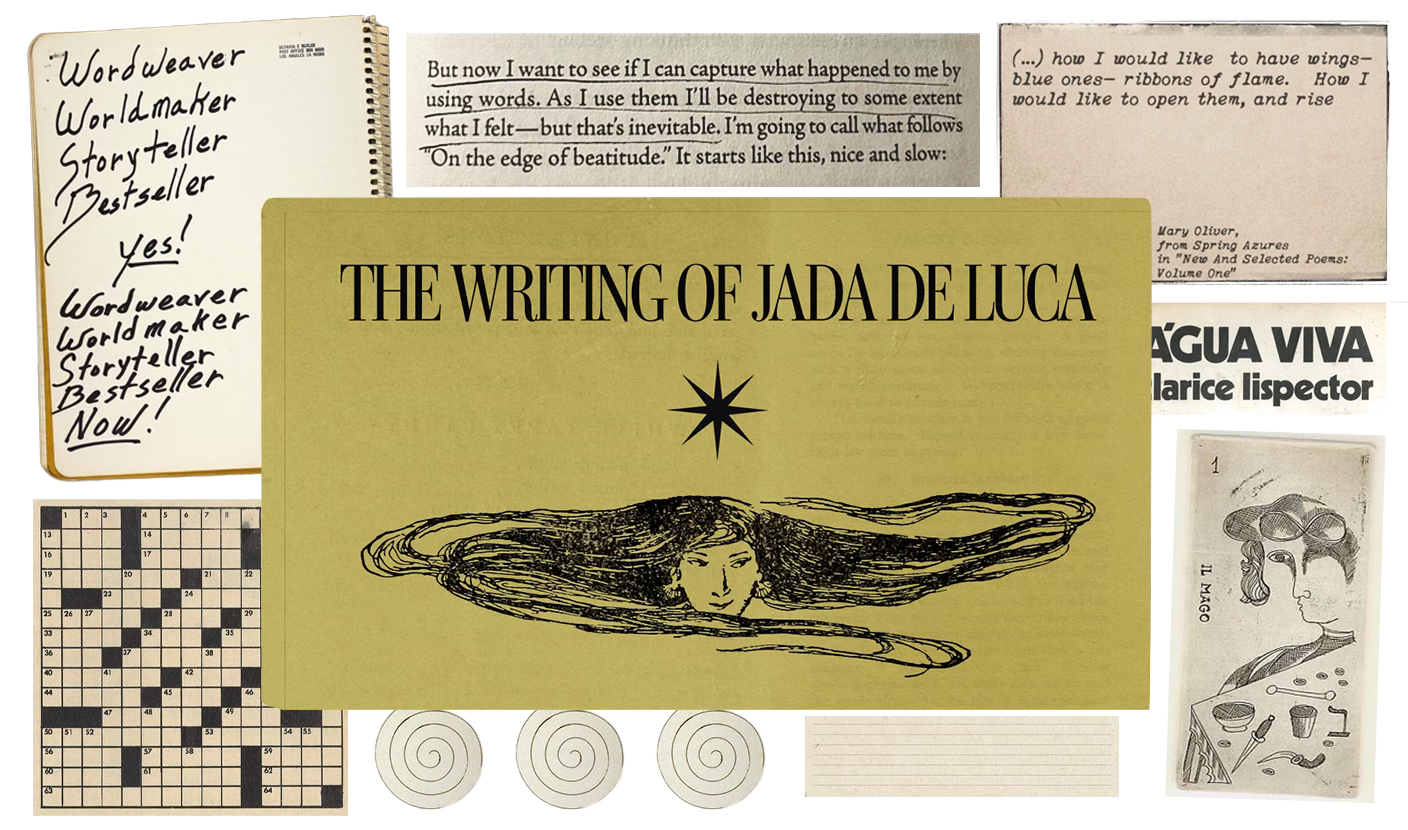
Italian-Samoan writer Jada De Luca is a visual narrator, storyteller and devout journaler. She writes about leading a reading and writing life, inspired by Mary Oliver’s poem Sometimes:
4.
Instructions for living a life:
Pay attention.
Be astonished.
Tell about it.
Telling stories through both written and visual narration (she is also a collage artist) is her way of paying attention to the magical, surreal, and intensely personal landscapes that the arts offer. Her newsletter is a source of her entire writing career; her oeuvre; a commonplace journal of essays about literature, language, writing, travel and art.
Jada’s favourite novel is Água Viva by Clarice Lispector, her favourite tarot card is The Magician, and she likes her tea with an extra sugar.
Having seen the screenshot of your notes you posted yesterday, it's so amazing to see the final product translated into such a detailed essay! As someone who has very limited art education, this was a fantastic read.
Your essay taught me so much about Remedios Varo and Leonora Carrington. I really like surrealist art, and I'm disappointed that I hadn't heard of these two artists before now. Your essay made me love this movement even more! Thank you for your incredible writing and for sharing your research about these artists and their work. This was an incredible essay! Keep doing what you're doing, your writing is beautiful, and needs to be heard :)